Video gait analysis on the treadmill: what to measure, how to film and how to interpret
Gait is the movement clinicians observe most often — and almost always by eye. With a camera and pose estimation, cadence, stance times, step length and sagittal angles can be measured with a known error, provided capture is standardised.
- With 2D video and OpenPose, the mean absolute error against 3D capture was 0.01–0.02 s for temporal parameters and 0.018–0.049 m for step length 1.
- Sagittal hip and knee angles have an error of about 4–6°; the ankle, about 7° 1,2.
- Frontal-plane pelvis and hip angles from pose estimation showed poor agreement with 3D on the treadmill 3.
- On the treadmill, kinematic differences from overground walking were generally under 2°, but kinetics differ 4,5.
- At least 6 minutes of treadmill familiarisation are needed before recording 6.
- Even in a 3D laboratory, between-session error in joint angles is around 2–3°; smaller changes should not be given weight 7.
Why gait analysis matters
Speed, cadence and step length are global markers of function. Knee flexion during loading response, hip extension in terminal stance and pelvic drop in the frontal plane help locate the deficit. Between-side symmetry is particularly relevant after lower-limb injury or surgery and in neurological patients.
For decades, quantifying these parameters required a motion analysis laboratory. Pose estimation applied to single-camera video has changed that. In a group of patients from a clinical gait laboratory, deep learning models predicted walking speed (r = 0.73), cadence (r = 0.79), knee flexion at maximum extension (r = 0.83) and the Gait Deviation Index (r = 0.75). The authors consider these values close to the ceiling imposed by the natural variability of these metrics 8.
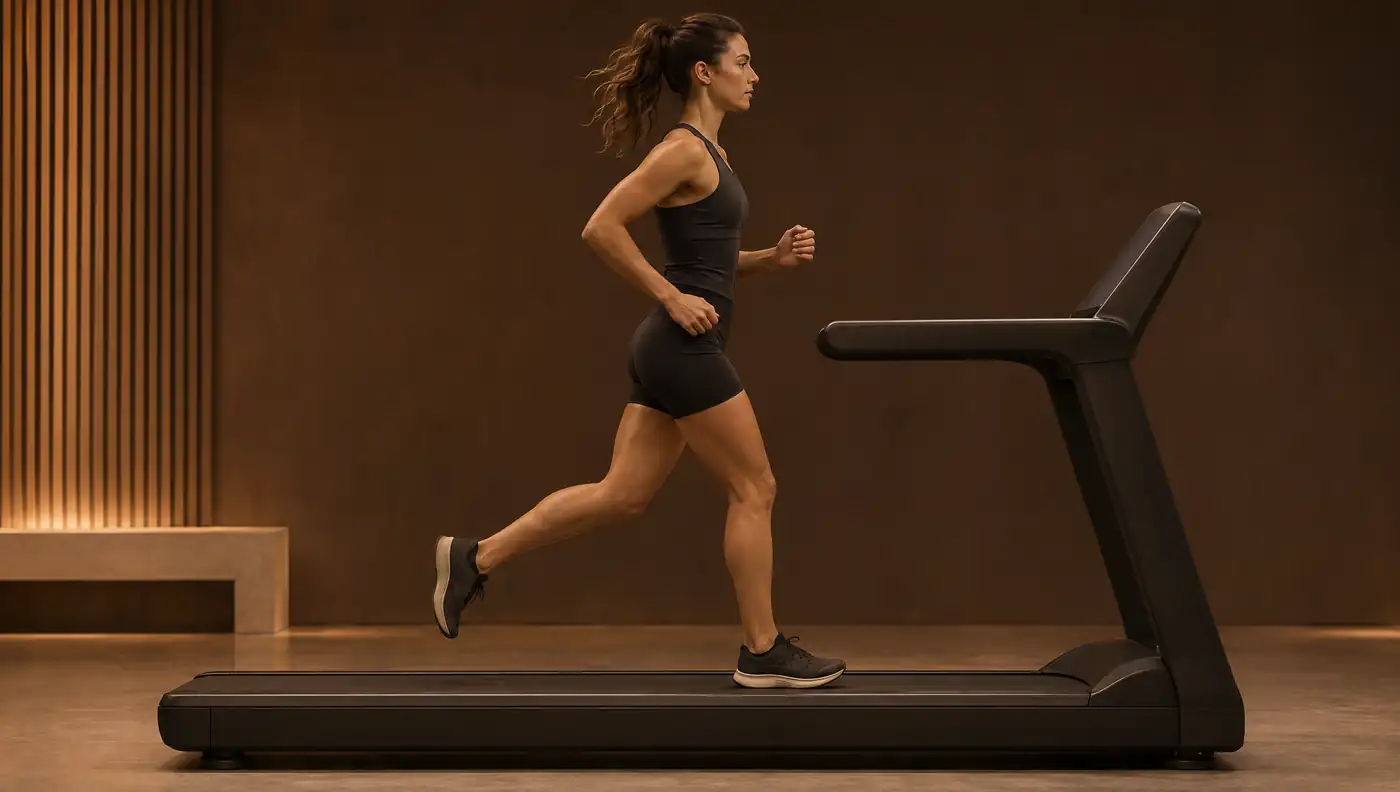
The treadmill adds two practical advantages: a fixed capture volume, with the subject always at the same distance from the camera, and many consecutive strides at the same speed. The trade-off is a slight difference from overground walking, discussed below.
What we measure and how each variable is defined
- Cadence: number of steps per minute. It is the main parameter of the “rhythm” domain of gait, alongside step and stride times 9.
- Stance time (contact time): duration of foot contact with the ground, from initial contact to toe-off. In adults aged 70 and over, stance occupied 63.9% of the gait cycle 9.
- Step length: anteroposterior distance between the heel of one foot and the heel of the contralateral foot 9.
- Knee flexion and hip extension: sagittal angles measured in the lateral view at defined events of the cycle (initial contact, loading response, terminal stance, swing).
- Pelvic drop: frontal-plane pelvic obliquity during single-leg stance, observed in the posterior or anterior view.
- Asymmetry: the difference between the right and left sides for any of the above variables.
On 2D video, all angles are projections onto a plane. A sagittal angle measured with the camera perpendicular to the direction of walking approximates the true angle well. A frontal pelvic angle is more sensitive to rotation and to occlusion of anatomical landmarks, and this is reflected in the validity data.
Standardised protocol and video capture
Familiarisation. In 40 healthy adults, 16 of 26 gait parameters adapted during the first minutes on the treadmill and stabilised within 6–7 minutes (425 strides). These included ankle range of motion, toe trajectory, foot clearance during swing and variability. Symmetry and inter-limb coordination required no adaptation. The recommendation is a minimum of 6 minutes, which is also sufficient for older adults and for people who have never walked on a treadmill 6.
Speed. The reference study comparing treadmill with overground walking used each subject's mean overground speed on the treadmill 4. Normative speed values help establish whether the patient's comfortable speed is reduced 10.
- A fixed camera, perpendicular to the plane of progression, with the subject centred in the field of view. Step length error depended on the subject's position in the frame and was smallest when they were in the centre 1.
- A lateral view for sagittal variables and a posterior view for the frontal plane, as in the treadmill validation study with lateral and posterior cameras 3.
- Use the mean of several strides per side. Averaging per participant reduced temporal error from 0.02 to 0.01 s and step length error from 0.049 to 0.018 m 1.
- There are no gait-specific studies on frame rate. The OpenPose validation used video at only 25 Hz 1; a higher frame rate should reduce error in event detection, but this is an inference, not a tested result.
Reference values
The available normative values were obtained overground, on timed walkways or on instrumented walkways, not on a treadmill. They serve to put the patient's speed and spatiotemporal parameters into context, not as cut-offs.
| Parameter | Value | Population and method | Source |
|---|---|---|---|
| Comfortable speed | From 143.4 cm/s (men, 40–49 years) to 94.3 cm/s (women, 80–99 years), depending on stratum | 23,111 adults, 41 studies, 3–30 m walkways | 10 |
| Comfortable speed (≥ 70 years) | ≈ 115 cm/s (men); ≈ 108 cm/s (women) | 294 adults aged 70 and over, GAITRite walkway | 9 |
| Cadence (≥ 70 years) | 109 ± 13 steps/min; men ≈ 103 steps/min; sex difference of 8.3 steps/min | As above | 9 |
| Step length (≥ 70 years) | ≈ 66 cm (men); ≈ 57 cm (women) | As above | 9 |
| Stance phase (≥ 70 years) | 63.9% of the gait cycle | As above | 9 |
Speed values may not apply to short walkways started on a “go” command or involving a change of direction 10.
For 2D joint angles on the treadmill, there is no published norm that can be used as a reference. The useful comparison is with the contralateral side and with the same patient's previous assessment.
Accuracy, reliability and measurement error
| Measure | Error | Source |
|---|---|---|
| Step, stance, swing and double-support times | 0.02 s per step; 0.01 s for the per-participant mean | 1 |
| Step length | 0.049 m per step; 0.018 m for the per-participant mean | 1 |
| Walking speed | Maximum difference < 0.10 m/s | 1 |
| Hip (sagittal) | 4.0° (OpenPose); 3.7 ± 1.3° (OpenPose) and 4.6 ± 1.8° (MoveNet Thunder) across the cycle | 1,2 |
| Knee (sagittal) | 5.6°; 5.1 ± 2.5° (OpenPose) | 1,2 |
| Ankle (sagittal) | 7.4° | 1 |
| Pelvis and hip (frontal) | Non-significant coefficients of determination, poor ICCs, fixed and proportional bias | 3 |
The Stenum and Washabaugh studies used overground walking in healthy adults; the Ota study used treadmill walking and running.
The pose estimation model matters: among four open-source models, OpenPose was the most accurate for the knee 2. In a markerless multi-camera smartphone system (OpenCap), tested in 10 adults on a treadmill at 4 km/h, spatiotemporal parameters had r ≥ 0.96 and a minimal detectable change (MDC) ≤ 0.01 m for stride length and ≤ 0.03 s for temporal variables. Sagittal ranges of motion had ICCs of 0.76–0.93 11.
To know which change is real, it helps to know the error of the reference standard itself. In a systematic review of 34 studies of marker-based 3D analysis, the between-session standard error of measurement (SEM) was 0.06 m/s for speed, typically ≤ 0.03 s for times and ≤ 0.03 m for distances. For joint angles, the median was 2.4° (sagittal), 1.9° (frontal) and 3.3° (transverse) 7. A 2° difference in an angle measured on video is within the error.
With the inertial sensors of a smartphone placed over the lumbosacral region, validity was good for step time (r = 0.97), speed (r = 0.83) and step length (r = 0.74). It was poor for step variability and asymmetry 12. Symmetry indices are therefore the metrics most in need of their own validation, whatever the technology.
Clinical interpretation and limitations
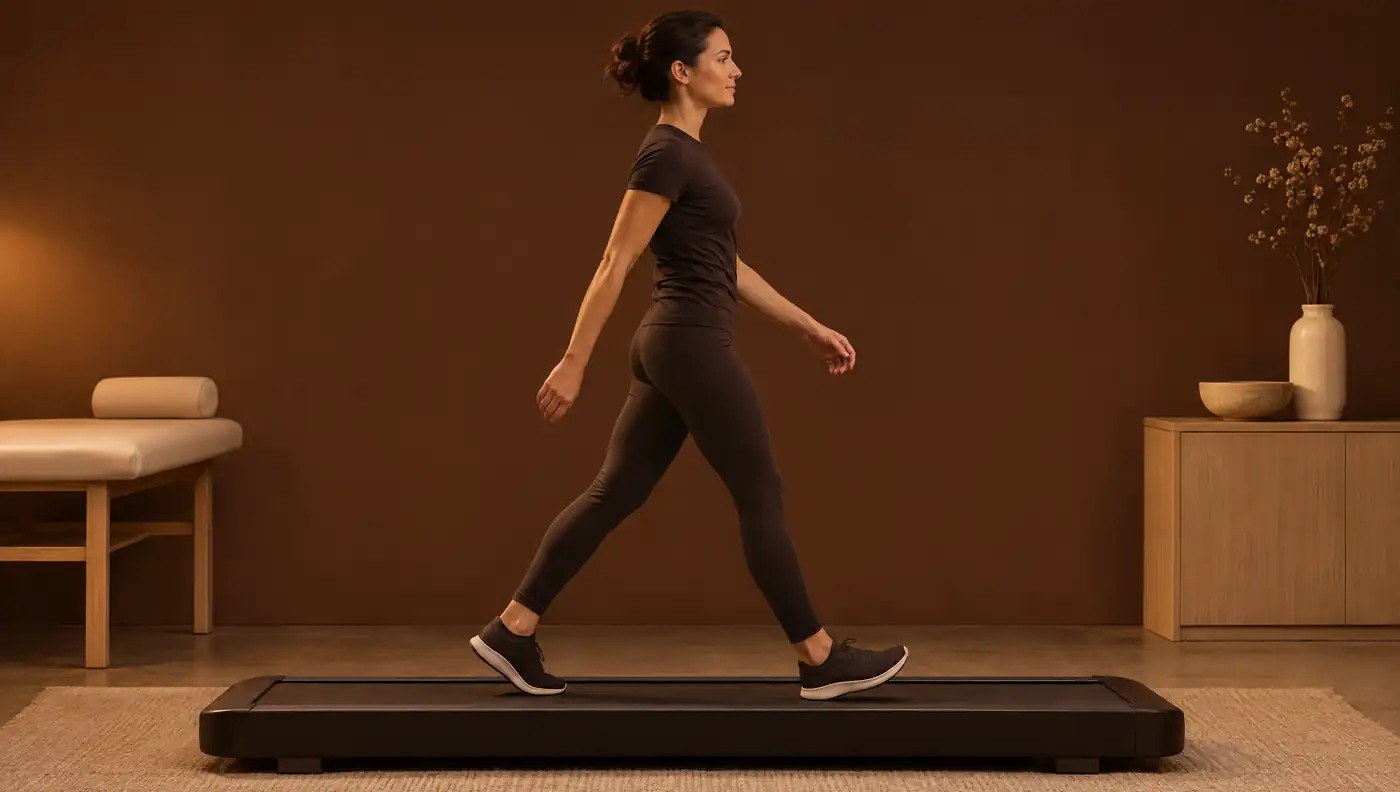
Treadmill versus overground. With speed matched, 12 of 22 kinematic peaks differed statistically, but generally by less than 2°. All ground reaction force peaks were lower on the treadmill, and the authors considered these differences comparable to normal gait variability 4. In another study, temporal parameters and kinematics barely differed. Sagittal joint moments were different: smaller dorsiflexor and knee extensor moments and a larger hip extensor moment on the treadmill 5. Treadmill kinematics represent overground kinematics well; joint loads cannot be inferred from video.
- 2D angles are projections: trunk or pelvic rotation and cameras that are not perpendicular alter the measured value 1.
- Frontal pelvis and hip values from pose estimation should be read as trends and between-side comparisons, not as absolute degrees 3.
- Spatiotemporal norms come from overground walking and specific populations, and do not replace the patient's own baseline assessment 10,9.
- An altered parameter describes the movement; it does not establish the cause. Diagnosis remains clinical.
Frequently asked questions
How do you do a gait analysis with smartphone video?
Fix the camera perpendicular to the direction of walking, with the patient in the centre of the frame, and use the mean of several strides. With pose estimation, temporal error was 0.01–0.02 s and sagittal hip and knee error about 4–6° 1,2.
What is a normal walking cadence?
It depends on age, sex and speed. In 294 healthy adults aged 70 and over, mean cadence was 109 ± 13 steps/min, with men at around 103 steps/min 9.
Is treadmill walking the same as overground walking?
Kinematics are very similar, with differences generally under 2° when speed is matched. Forces and joint moments differ 4,5.
How long should treadmill familiarisation be before a gait assessment?
At least 6 minutes. The parameters that adapt stabilised within 6–7 minutes (425 strides), including in older adults and in people who had never used a treadmill 6.
Is pose estimation reliable for measuring pelvic drop during gait?
Not yet in absolute terms. On the treadmill, frontal pelvis and hip angles from OpenPose had poor ICCs against 3D, unlike sagittal ranges of motion 3.
References
- Stenum J, Rossi C, Roemmich RT. Two-dimensional video-based analysis of human gait using pose estimation. PLoS Comput Biol. 2021;17(4):e1008935. doi.org/10.1371/journal.pcbi.1008935
- Washabaugh EP, Shanmugam TA, Ranganathan R, Krishnan C. Comparing the accuracy of open-source pose estimation methods for measuring gait kinematics. Gait Posture. 2022;97:188–195. doi.org/10.1016/j.gaitpost.2022.08.008
- Ota M, Tateuchi H, Hashiguchi T, Ichihashi N. Verification of validity of gait analysis systems during treadmill walking and running using human pose tracking algorithm. Gait Posture. 2021;85:290–297. doi.org/10.1016/j.gaitpost.2021.02.006
- Riley PO, Paolini G, Della Croce U, Paylo KW, Kerrigan DC. A kinematic and kinetic comparison of overground and treadmill walking in healthy subjects. Gait Posture. 2007;26(1):17–24. doi.org/10.1016/j.gaitpost.2006.07.003
- Lee SJ, Hidler J. Biomechanics of overground vs. treadmill walking in healthy individuals. J Appl Physiol (1985). 2008;104(3):747–755. doi.org/10.1152/japplphysiol.01380.2006
- Meyer C, Killeen T, Easthope CS, Curt A, Bolliger M, Linnebank M, et al. Familiarization with treadmill walking: How much is enough? Sci Rep. 2019;9(1):5232. doi.org/10.1038/s41598-019-41721-0
- Horsak B, Kranzl A, Slijepcevic D, Svehlik M, Dumphart B. Test-retest reliability of spatiotemporal, kinematic, and kinetic measures in marker-based 3D gait analysis: a systematic review. Gait Posture. 2026;130:110270. doi.org/10.1016/j.gaitpost.2026.110270
- Kidziński Ł, Yang B, Hicks JL, Rajagopal A, Delp SL, Schwartz MH. Deep neural networks enable quantitative movement analysis using single-camera videos. Nat Commun. 2020;11(1):4054. doi.org/10.1038/s41467-020-17807-z
- Hollman JH, McDade EM, Petersen RC. Normative spatiotemporal gait parameters in older adults. Gait Posture. 2011;34(1):111–118. doi.org/10.1016/j.gaitpost.2011.03.024
- Bohannon RW, Williams Andrews A. Normal walking speed: a descriptive meta-analysis. Physiotherapy. 2011;97(3):182–189. doi.org/10.1016/j.physio.2010.12.004
- Borba EF, Inda AR, Herberts BM, Alves LL, Ibrahim BM, Fernandes FMM, et al. Agreement and repeatability of a smartphone-based markerless system (OpenCap) versus marker-based motion capture during treadmill walking and running. J Appl Biomech. 2026;42(5):409–418. doi.org/10.1123/jab.2026-0021
- Olsen S, Rashid U, Barbado D, Suresh P, Alder G, Khan Niazi I, et al. The validity of smartphone-based spatiotemporal gait measurements during walking with and without head turns: comparison with the GAITRite® system. J Biomech. 2024;162:111899. doi.org/10.1016/j.jbiomech.2023.111899
Educational content for health professionals. It does not replace clinical assessment or reading the original studies.