Drop jump: dynamic knee valgus, KASR and RSI — what to measure, how to film and how to interpret
A drop jump from a box of about 30 cm combines, in a single movement, frontal-plane knee control on landing and reactive capacity. It is a good test for profiling and monitoring an athlete — and a poor test for predicting who will rupture their ACL.
- In a prospective study of 205 female athletes, the knee abduction moment during the drop vertical jump identified the 9 future ACL ruptures with 78% sensitivity and 73% specificity 1.
- In a cohort of 710 elite athletes, the AUC was 0.6, and no test variable was associated with risk in athletes without a previous injury 2.
- KASR explained more of the variance in 3D knee abduction than FPPA (r² 0.350 vs 0.145) 3.
- In active adults, FPPA during the drop jump ranged from 7–13° in women and 3–8° in men 4.
- Between-session FPPA differences smaller than about 8–9° may be nothing more than measurement error 5.
- With smartphone video, RSI and contact time showed ICCs of 0.92–0.99 against a force plate 6.
Why the drop jump matters
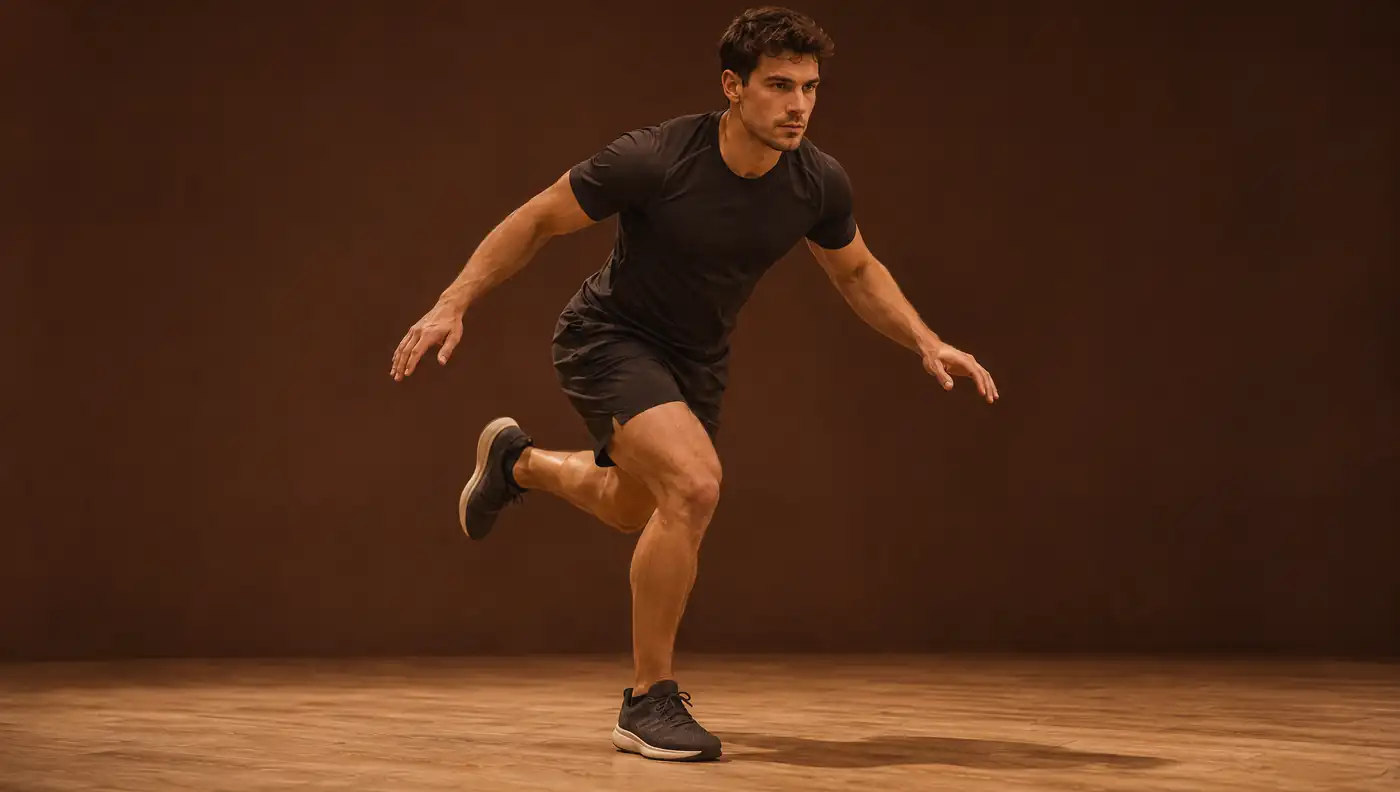
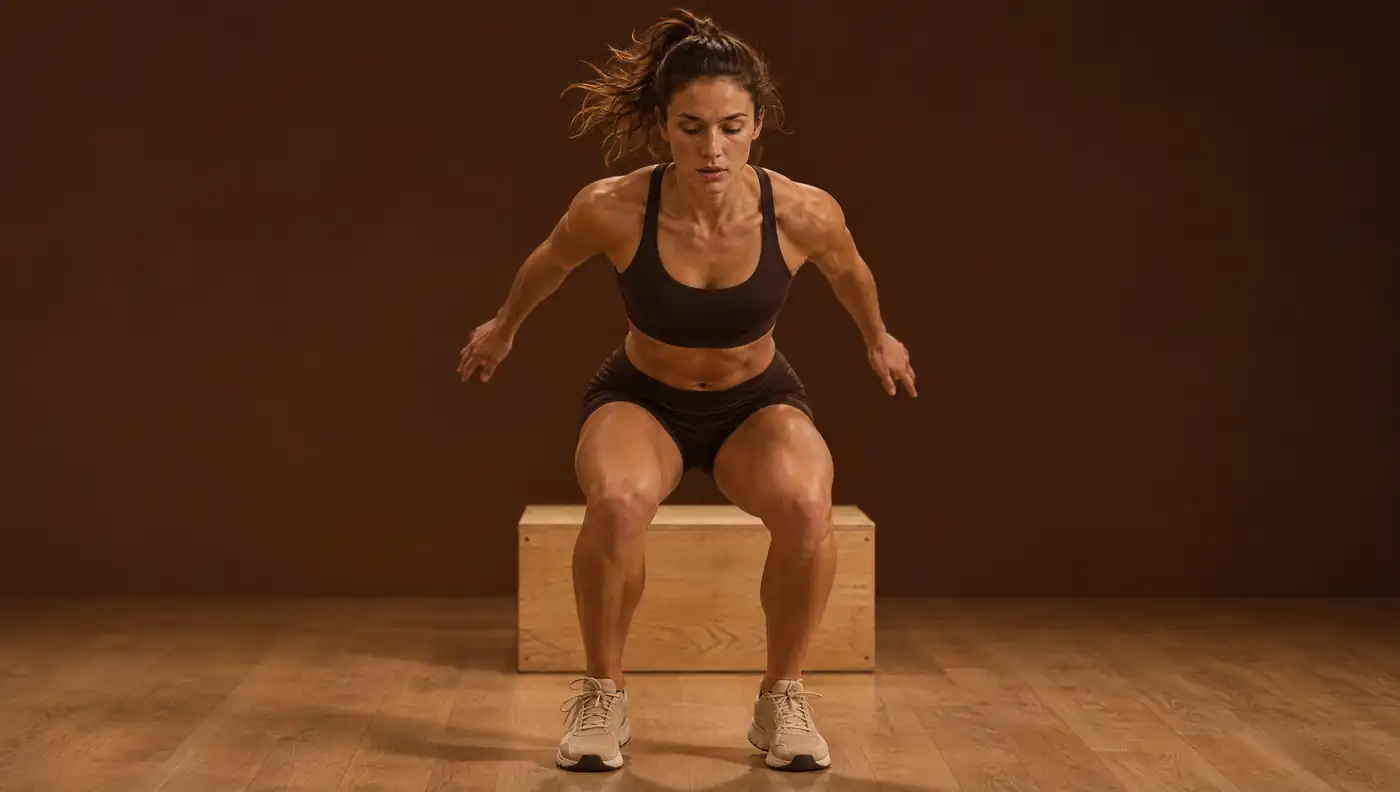
In the drop vertical jump (DVJ), the athlete drops from a box, lands on both feet and immediately jumps vertically with maximal effort. The first landing exposes control of lower-limb alignment in the frontal plane; the transition into the jump exposes the ability to use the stretch-shortening cycle. It is therefore a test that serves both the physiotherapist concerned about the knee and the strength and conditioning coach interested in reactivity.
The test owes its popularity to a prospective study: among 205 female football, basketball and volleyball players, the 9 who went on to rupture their ACL landed with 8° more knee abduction, a 2.5-fold greater abduction moment, 20% higher ground reaction force and 16% shorter stance time 1. In parallel, Noyes's group developed a frontal video version that measures the separation between the knees and the ankles 7. It had already been reported that, in the DVJ, female athletes showed more valgus and a greater difference between the dominant and non-dominant sides than male athletes 8.
The test is useful in athletes from sports involving jumping, cutting and changes of direction, in knee rehabilitation when plyometrics are reintroduced, and for monitoring neuromuscular training programmes.
What we measure and how each variable is defined
- FPPA (frontal plane projection angle): the angle between thigh and shank on the frontal image, defined by the hip, knee and ankle. It is a 2D projection, not true 3D knee abduction 3.
- KASR (knee-to-ankle separation ratio): the distance between the knees divided by the distance between the ankles. Values below 1 indicate knees medial to the ankles, i.e. dynamic valgus 3. It derives from the hip-normalised knee separation proposed by Noyes 7.
- Contact time: the time between the first landing and leaving the ground for the jump.
- RSI (reactive strength index): jump height divided by contact time 9. Contact time tells you how the athlete jumps; RSI tells you how well, and both can guide and monitor plyometric training 10.
- R/L asymmetry: the between-side difference in bilateral variables such as FPPA.
An important point: what you see on video is not the same as joint loading. In 60 elite female footballers, visual rating of knee control correlated moderately with the valgus angle (0.54–0.60) but poorly with the abduction moment (0.09–0.11) 11.
Standardised protocol and video capture
Published protocols vary in box height: 30 cm 12, 31 cm 3, a 28 cm step 5, or 20 and 40 cm in the smartphone validation studies 6. A box of about 30 cm is the most common choice.
- Position and instruction: feet shoulder-width apart on the box; drop off, land with one foot either side and immediately jump vertically with maximal effort, raising the arms as if going for a basketball rebound 3.
- Camera: frontal and perpendicular to the athlete. In the KASR validation study, the camera was on a tripod 3 m away and 0.3 m above the floor, with analysis at 30 Hz 3.
- Analysis time point: Mizner analysed peak knee flexion on the first landing 3. With pose estimation, excursion from initial contact is more valid than the absolute angle 13.
- Repetitions: three familiarisation trials followed by three valid trials 3. For RSI, a single trial proved consistent 12; for frontal-plane kinematics, the mean of several trials is preferable.
Reference values
Few normative values have been published, and almost all come from specific populations. They should be used as context, not as a cut-off.
| Variable | Value | Population | Source |
|---|---|---|---|
| FPPA (2D) | 7–13°, symmetrical | Active women, 18–28 years (n = 50) | 4 |
| FPPA (2D) | 3–8°, symmetrical | Active men, 18–28 years (n = 50) | 4 |
| FPPA (2D), mean | −7.6° (negative = valgus) | Female collegiate athletes (n = 36) | 3 |
| KASR, mean | 0.76 | Female collegiate athletes (n = 36) | 3 |
| Normalised knee separation | 51% ± 19% (F); 51% ± 15% (M) | Athletes aged 11 to 19 years (n = 455) | 7 |
| Normalised separation ≤ 60% of hip width | 93% of girls; 76% of boys | Athletes aged 9–10 years (n = 52) | 14 |
| 3D valgus by visual rating | Poor 10.3°; reduced 5.4°; good 1.9° | Elite female footballers (n = 60) | 11 |
The ≤ 60% threshold describes “clearly valgus” alignment; it is not a validated risk cut-off. No verified population norms were found for RSI.
In young athletes, valgus alignment on landing is the rule rather than the exception: in 1140 athletes aged 9 to 17 there was no effect of age or sex on limb alignment, and most landed in valgus 15. For RSI and contact time, the most useful comparison is the athlete against themselves, with the same box height.
Reliability and measurement error
FPPA on 2D video. In 20 students, the ICC was 0.59–0.88 within day and 0.72–0.91 between days, with a standard error of measurement of 2.72–3.01° and a smallest detectable difference of 7.54–8.93° 5. A 5° improvement between two sessions therefore cannot be distinguished from noise. In Mizner's validation, inter-rater reliability for FPPA and KASR was ICC 0.89–0.94; the mean absolute error against motion capture was 3.3 ± 3.9° for FPPA and 0.045 ± 0.041 for KASR 3.
Pose estimation. With OpenPose, knee valgus during the DVJ had a mean absolute error of 2.4° (95% CI 1.9–3.0°) against 3D, similar to that of an experienced physiotherapist (3.2°), and a correlation of 0.97 16. With MediaPipe, in a single-leg landing, absolute angles deviated by about 19° from 3D, but excursion from initial contact showed good reliability and validity 13. A markerless system using several smartphones (OpenCap) showed an RMSE above 6° for frontal-plane knee kinematics 17.
RSI and contact time. On a force plate, jump height, contact time and RSI had between-trial ICCs > 0.9 12. With iPhone video (My Jump 2), RSI had an ICC of 0.95 at 20 cm and 0.98 at 40 cm, and contact time ICCs of 0.99 and 0.92 6. In an earlier study, countermovement jump height measured on an iPhone had an ICC of 0.997 18.
Asymmetry. The “weaker” side may change between sessions. In the single-leg drop jump, agreement on the direction of asymmetry was substantial for jump height (κ = 0.72) but only fair for reactive strength (κ = 0.25) 19.
Clinical interpretation and limitations
The 2D projection is an approximation. KASR explained about 35–39% of the variance in 3D abduction and abduction moment, and FPPA 15–25% 3. Between individuals, 2D tracks 3D reasonably well; within the same individual, the relationship is weaker (r² 0.25–0.36) 20.
Injury prediction. The 78% and 73% from the original study were based on 9 injuries 1. In a cohort of 710 elite athletes with 42 non-contact ruptures, only medial knee displacement was associated with risk (OR 1.40 per standard deviation), with an AUC of 0.6; in the 643 athletes without a previous injury, no variable was associated with risk 2. In 171 young female players, frontal-plane variables were not associated with risk; lower knee flexion and higher vertical force were, but with an AUC of 0.6–0.7 21. Visual rating of the DVJ by physiotherapists in 880 athletes had an AUC of 0.43–0.54 22.
There are two further practical limitations. The frontal camera does not see sagittal stiffness, i.e. limited knee flexion, which was precisely the positive finding in young female players 21. And the bilateral DVJ does not replace the single-leg squat: the two tests identified different athletes with poor knee control 23.
Frequently asked questions
What is a normal FPPA in the drop jump?
In physically active adults, 2D valgus during the drop jump ranged from 7–13° in women and 3–8° in men, and should be symmetrical 4. These values come from a single population aged 18 to 28.
What is KASR in the drop vertical jump?
It is the ratio of the distance between the knees to the distance between the ankles; a value below 1 indicates dynamic valgus. It explained more of the variance in 3D knee abduction than FPPA 3.
How do you calculate RSI from a drop jump?
RSI = jump height ÷ contact time 9. On a force plate it is highly reliable (ICC > 0.9) 12, and it can be measured with smartphone video 6.
References
- Hewett TE, Myer GD, Ford KR, Heidt RS Jr, Colosimo AJ, McLean SG, et al. Biomechanical measures of neuromuscular control and valgus loading of the knee predict anterior cruciate ligament injury risk in female athletes: a prospective study. Am J Sports Med. 2005;33(4):492–501. doi.org/10.1177/0363546504269591
- Krosshaug T, Steffen K, Kristianslund E, Nilstad A, Mok KM, Myklebust G, et al. The vertical drop jump is a poor screening test for ACL injuries in female elite soccer and handball players: a prospective cohort study of 710 athletes. Am J Sports Med. 2016;44(4):874–883. doi.org/10.1177/0363546515625048
- Mizner RL, Chmielewski TL, Toepke JJ, Tofte KB. Comparison of 2-dimensional measurement techniques for predicting knee angle and moment during a drop vertical jump. Clin J Sport Med. 2012;22(3):221–227. doi.org/10.1097/JSM.0b013e31823a46ce
- Herrington L, Munro A. Drop jump landing knee valgus angle; normative data in a physically active population. Phys Ther Sport. 2010;11(2):56–59. doi.org/10.1016/j.ptsp.2009.11.004
- Munro A, Herrington L, Carolan M. Reliability of 2-dimensional video assessment of frontal-plane dynamic knee valgus during common athletic screening tasks. J Sport Rehabil. 2012;21(1):7–11. doi.org/10.1123/jsr.21.1.7
- Haynes T, Bishop C, Antrobus M, Brazier J. The validity and reliability of the My Jump 2 app for measuring the reactive strength index and drop jump performance. J Sports Med Phys Fitness. 2019;59(2):253–258. doi.org/10.23736/S0022-4707.18.08195-1
- Noyes FR, Barber-Westin SD, Fleckenstein C, Walsh C, West J. The drop-jump screening test: difference in lower limb control by gender and effect of neuromuscular training in female athletes. Am J Sports Med. 2005;33(2):197–207. doi.org/10.1177/0363546504266484
- Ford KR, Myer GD, Hewett TE. Valgus knee motion during landing in high school female and male basketball players. Med Sci Sports Exerc. 2003;35(10):1745–1750. doi.org/10.1249/01.MSS.0000089346.85744.D9
- Ebben WP, Petushek EJ. Using the reactive strength index modified to evaluate plyometric performance. J Strength Cond Res. 2010;24(8):1983–1987. doi.org/10.1519/JSC.0b013e3181e72466
- Flanagan EP, Comyns TM. The use of contact time and the reactive strength index to optimize fast stretch-shortening cycle training. Strength Cond J. 2008;30(5):32–38. doi.org/10.1519/SSC.0b013e318187e25b
- Nilstad A, Andersen TE, Kristianslund E, Bahr R, Myklebust G, Steffen K, et al. Physiotherapists can identify female football players with high knee valgus angles during vertical drop jumps using real-time observational screening. J Orthop Sports Phys Ther. 2014;44(5):358–365. doi.org/10.2519/jospt.2014.4969
- Flanagan EP, Ebben WP, Jensen RL. Reliability of the reactive strength index and time to stabilization during depth jumps. J Strength Cond Res. 2008;22(5):1677–1682. doi.org/10.1519/JSC.0b013e318182034b
- Asaeda M, Onishi T, Ito H, Miyahara S, Mikami Y. Reliability and validity of knee valgus angle calculation at single-leg drop landing by posture estimation using machine learning. Heliyon. 2024;10(17):e36338. doi.org/10.1016/j.heliyon.2024.e36338
- Barber-Westin SD, Galloway M, Noyes FR, Corbett G, Walsh C. Assessment of lower limb neuromuscular control in prepubescent athletes. Am J Sports Med. 2005;33(12):1853–1860. doi.org/10.1177/0363546505278257
- Barber-Westin SD, Noyes FR, Galloway M. Jump-land characteristics and muscle strength development in young athletes: a gender comparison of 1140 athletes 9 to 17 years of age. Am J Sports Med. 2006;34(3):375–384. doi.org/10.1177/0363546505281242
- Ino T, Samukawa M, Ishida T, Wada N, Koshino Y, Kasahara S, et al. Validity and reliability of OpenPose-based motion analysis in measuring knee valgus during drop vertical jump test. J Sports Sci Med. 2024;23(1):515–525. doi.org/10.52082/jssm.2024.515
- Färber B, Horsak B, Paternoster FK. Concurrent validation of OpenCap for identifying ACL re-injury risk factors during a drop jump test in a healthy cohort. Sci Rep. 2026;16(1):9843. doi.org/10.1038/s41598-026-44758-0
- Balsalobre-Fernández C, Glaister M, Lockey RA. The validity and reliability of an iPhone app for measuring vertical jump performance. J Sports Sci. 2015;33(15):1574–1579. doi.org/10.1080/02640414.2014.996184
- Bishop C, Perez-Higueras Rubio M, Gullon IL, Maloney S, Balsalobre-Fernandez C. Jump and change of direction speed asymmetry using smartphone apps: between-session consistency and associations with physical performance. J Strength Cond Res. 2022;36(4):927–934. doi.org/10.1519/JSC.0000000000003567
- McLean SG, Walker K, Ford KR, Myer GD, Hewett TE, van den Bogert AJ. Evaluation of a two dimensional analysis method as a screening and evaluation tool for anterior cruciate ligament injury. Br J Sports Med. 2005;39(6):355–362. doi.org/10.1136/bjsm.2005.018598
- Leppänen M, Pasanen K, Kujala UM, Vasankari T, Kannus P, Äyrämö S, et al. Stiff landings are associated with increased ACL injury risk in young female basketball and floorball players. Am J Sports Med. 2017;45(2):386–393. doi.org/10.1177/0363546516665810
- Petushek E, Nilstad A, Bahr R, Krosshaug T. Drop jump? Single-leg squat? Not if you aim to predict anterior cruciate ligament injury from real-time clinical assessment: a prospective cohort study involving 880 elite female athletes. J Orthop Sports Phys Ther. 2021;51(7):372–378. doi.org/10.2519/jospt.2021.10170
- Stensrud S, Myklebust G, Kristianslund E, Bahr R, Krosshaug T. Correlation between two-dimensional video analysis and subjective assessment in evaluating knee control among elite female team handball players. Br J Sports Med. 2011;45(7):589–595. doi.org/10.1136/bjsm.2010.078287
Educational content for health professionals. It does not replace clinical assessment or reading the original studies.