
Hop and hold: time to stabilisation — protocol, values and interpretation
Hopping, landing on one leg and holding still sounds simple. Measuring how long the body takes to “settle” reveals deficits that static balance does not show — provided the protocol and the calculation method are clearly defined.
- With functional ankle instability, time to stabilisation was 1.98 ± 0.81 s, compared with 1.45 ± 0.30 s in stable ankles 1.
- Static single-leg sway did not distinguish stable from unstable ankles; the jump-landing stabilisation task did 2.
- Recording duration alone changed time to stabilisation by about 100%: there is no universal norm 3.
- Reliability is moderate, with ICCs of 0.51–0.86 depending on the task 4.
- In 190 elite footballers, stability in the first 0.4 s and sway between 3 and 5 s after landing were associated with ankle sprains 5.
Why the hop and hold matters
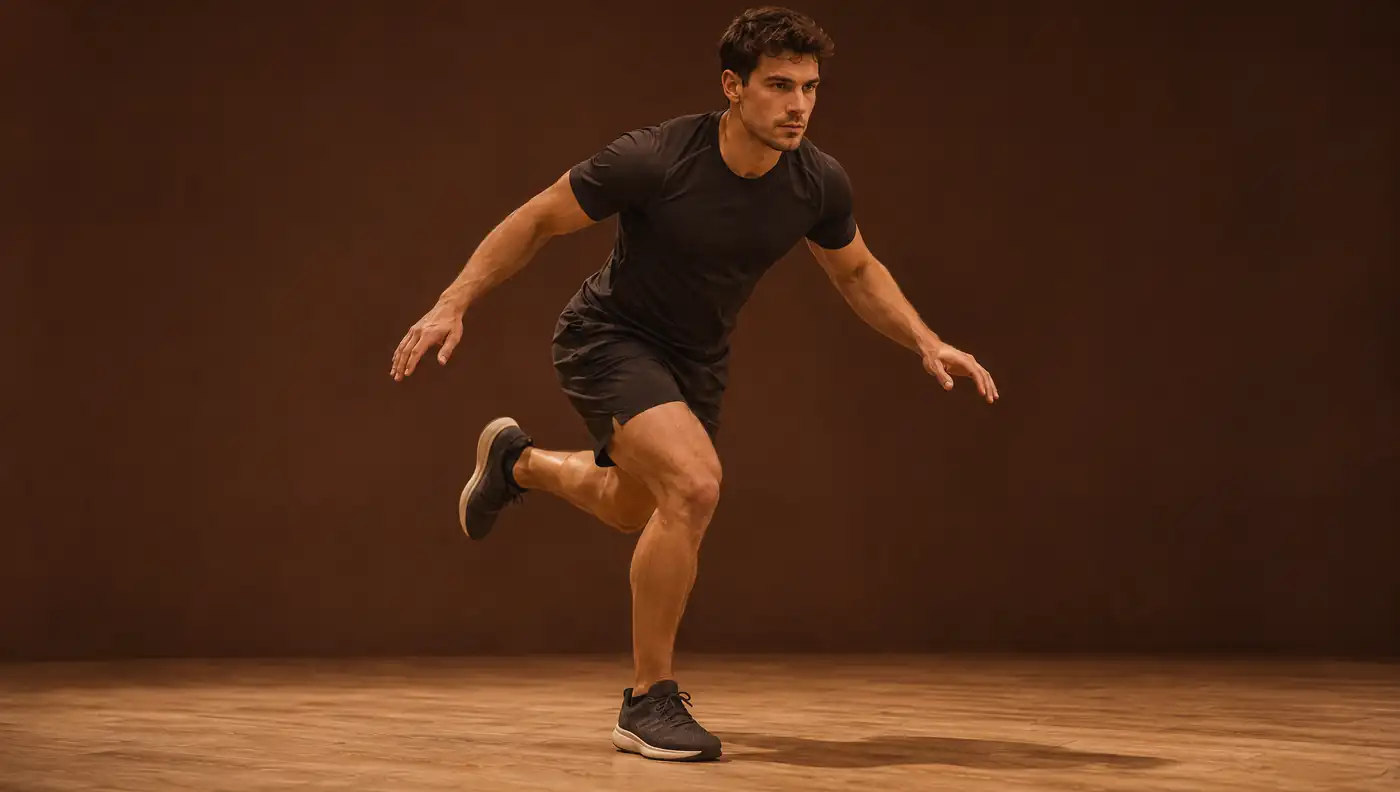
In the hop and hold (single-leg jump-landing stabilisation), the athlete hops, lands on one foot and tries to become still as quickly as possible. The classic variable is time to stabilisation (TTS): the time the signal takes to return to a stable state after landing 3. It measures dynamic postural control, i.e. the transition from impact to stable single-leg support.
One of its first applications was after ACL injury: during a step-down, the reconstructed limb took 1527 ± 216 ms to stabilise, compared with 892 ± 498 ms in the uninjured limb 6. Most of the evidence came later, in ankle instability. In 14 people with functional instability and 14 controls, static sway did not differ, but anteroposterior TTS was 3.27 ± 0.72 s versus 2.33 ± 0.33 s, and mediolateral TTS 2.48 ± 0.50 s versus 2.00 ± 0.65 s 2.
A meta-analysis of 23 studies confirmed the association between functional instability and poorer balance (standardised mean difference 0.455; 95% CI 0.334–0.577), with TTS among the significant dynamic measures 7. A systematic review of 20 studies described, in chronic ankle instability, deficits in dynamic stability with medium to large effect sizes and altered ankle and knee kinematics during single-leg landing 8. To define chronic instability in research, the International Ankle Consortium has published consensus selection criteria 9.
What we measure and how each variable is defined
TTS is not a single measure but a family of methods. One analysis compared 18 published methods, which differ in four respects 3:
- the input signal (vertical, anteroposterior or mediolateral ground reaction force);
- the processing (sequential averaging, a moving RMS window, or fitting an unbounded third-order polynomial);
- the threshold that defines the stable state;
- the criterion beyond which the processed signal is considered stable.
The method changes the numbers. With the same data, the third-order polynomial gave 2554.4 ± 68.7 ms and the sequential estimation 1360.8 ± 52.1 ms 10. Alternatives have therefore emerged: the dynamic postural stability index (DPSI), highly reliable between sessions (ICC 0.96; SEM 0.03) over a 3 s window 11, and phase-specific measures such as mediolateral stability in the first 0.4 s and horizontal force between 3 and 5 s 5.
On video, the equivalent is estimated from the movement of the joint keypoints rather than from force. It should be presented as an estimate, with the algorithm and time window stated explicitly.
Standardised protocol and capture
- Ross and Guskiewicz: jump to 50–55% of maximal vertical jump height, land on one leg, stabilise quickly and remain as still as possible for 20 s 2,1.
- Wikstrom: start 70 cm from the centre of the force plate, jump off both feet to touch a marker set at 50% of maximal vertical jump and land on one foot; alternatively, step down from a 20 cm step 10.
- Choice of task: the jump produced a longer vertical TTS than the step-down (2381.7 vs 1533.5 ms), and the jump combined with the third-order polynomial was the combination that best distinguished unstable ankles 10.
- Arms and habituation: in a depth jump protocol without arm control, TTS was not reliable; the authors recommend habituation and control of arm movement 12.
- Repetitions: several trials per side; one methodological study used 10 landings per participant 3.
Reference values
The values below are only comparable within the same protocol and the same calculation method. They serve to show the order of magnitude and the size of between-group differences.
| Group or condition | TTS | Protocol | Source |
|---|---|---|---|
| Stable ankles vs functional instability | 1.45 ± 0.30 s vs 1.98 ± 0.81 s | Jump at 50–55% of maximum, 20 s | 1 |
| Stable vs unstable, anteroposterior | 2.33 ± 0.33 s vs 3.27 ± 0.72 s | Jump at 50–55% of maximum, 20 s | 2 |
| Stable vs unstable, mediolateral | 2.00 ± 0.65 s vs 2.48 ± 0.50 s | Jump at 50–55% of maximum, 20 s | 2 |
| Jump vs step-down (vertical) | 2381.7 vs 1533.5 ms | Jump at 50% / 20 cm step | 10 |
| Post-ACL: reconstructed vs healthy limb | 1527 ± 216 vs 892 ± 498 ms | Step-down | 6 |
Values obtained with force plates and different methods. No normative values were found for time to stabilisation measured on video.
Reliability and measurement error
Ross and colleagues reported an ICC of 0.79 (SEM 0.15 s) in the anteroposterior direction and 0.65 (SEM 0.26 s) in the mediolateral direction 1. From these values, the 95% minimal detectable change (1.96 × √2 × SEM) is about 0.42 s and 0.72 s — our own calculation, not the authors'. This is practically the difference between stable and unstable ankles, about 0.5 s, which means the mean of several trials must be used.
Across seven plyometric exercises, TTS ICCs ranged from 0.51 to 0.86, with no differences between trials 4. In a depth jump protocol from 30 cm, TTS was not reliable (single-measure ICC < 0.5), unlike RSI 12. Sampling rate and filtering changed the result little (2.8% and 8.8%), but trial duration changed it by 100.5% 3.
With consumer sensors — a smartphone placed on the chest, in 76 participants — agreement with the force plate was good for early balance (lower bound of ICC > 0.87) and only moderate for late balance (> 0.65), with systematic overestimation 13. No published validation was found for time to stabilisation derived from video with pose estimation.
Clinical interpretation and limitations
Discriminative value. TTS distinguishes groups with and without ankle instability 7,8. Prognostic value. In 190 elite footballers, 45 (23.7%) sustained a first lateral ankle sprain within 3 years; a player 2 standard deviations below the mean on both factors — early mediolateral stability and late sway — had a 4.4-fold greater likelihood of a sprain 5. This is a prospective association, not a validated cut-off.
Prescription. TTS differed between plyometric exercises and allows them to be ranked by stabilisation demand, which helps progress load during rehabilitation 4.
Return to sport after ACL. Hop tests form part of limb symmetry batteries. Single-leg hop tests had low sensitivity but high specificity: 50% of patients with ACL rupture had abnormal symmetry on one test and 62% when two were combined 14. In 106 patients, 38.2% of those who failed the criteria (scores > 90 on all tests) were re-injured, compared with 5.6% of those who met them — a non-significant difference (p = 0.075); delaying return until 9 months and quadriceps strength symmetry carried more weight 15. In 158 professional athletes, failing to meet the six discharge criteria was associated with a 4.1-fold greater risk of graft rupture 16.
Frequently asked questions
What is time to stabilisation (TTS)?
It is the time the body takes to return to a stable state after landing on one leg. There are at least 18 published calculation methods, and they give different values 3.
What is a normal time to stabilisation?
It depends on the protocol. In a jump at 50–55% of maximum, stable ankles had 1.45 ± 0.30 s and unstable ankles 1.98 ± 0.81 s 1; there is no universal norm.
How do you perform the hop and hold test?
In a classic protocol, the athlete jumps to 50–55% of their maximal vertical jump, lands on one foot and stays as still as possible for 20 s 2. Keep arm position and recording duration constant.
References
- Ross SE, Guskiewicz KM, Yu B. Single-leg jump-landing stabilization times in subjects with functionally unstable ankles. J Athl Train. 2005;40(4):298–304. pubmed.ncbi.nlm.nih.gov/16404451/
- Ross SE, Guskiewicz KM. Examination of static and dynamic postural stability in individuals with functionally stable and unstable ankles. Clin J Sport Med. 2004;14(6):332–338. doi.org/10.1097/00042752-200411000-00002
- Fransz DP, Huurnink A, de Boode VA, Kingma I, van Dieën JH. Time to stabilization in single leg drop jump landings: an examination of calculation methods and assessment of differences in sample rate, filter settings and trial length on outcome values. Gait Posture. 2015;41(1):63–69. doi.org/10.1016/j.gaitpost.2014.08.018
- Ebben WP, Vanderzanden T, Wurm BJ, Petushek EJ. Evaluating plyometric exercises using time to stabilization. J Strength Cond Res. 2010;24(2):300–306. doi.org/10.1519/JSC.0b013e3181cbaadd
- Fransz DP, Huurnink A, Kingma I, de Boode VA, Heyligers IC, van Dieën JH. Performance on a single-legged drop-jump landing test is related to increased risk of lateral ankle sprains among male elite soccer players: a 3-year prospective cohort study. Am J Sports Med. 2018;46(14):3454–3462. doi.org/10.1177/0363546518808027
- Colby SM, Hintermeister RA, Torry MR, Steadman JR. Lower limb stability with ACL impairment. J Orthop Sports Phys Ther. 1999;29(8):444–451. doi.org/10.2519/jospt.1999.29.8.444
- Arnold BL, De La Motte S, Linens S, Ross SE. Ankle instability is associated with balance impairments: a meta-analysis. Med Sci Sports Exerc. 2009;41(5):1048–1062. doi.org/10.1249/MSS.0b013e318192d044
- Simpson JD, Stewart EM, Macias DM, Chander H, Knight AC. Individuals with chronic ankle instability exhibit dynamic postural stability deficits and altered unilateral landing biomechanics: a systematic review. Phys Ther Sport. 2019;37:210–219. doi.org/10.1016/j.ptsp.2018.06.003
- Gribble PA, Delahunt E, Bleakley C, Caulfield B, Docherty C, Fourchet F, et al. Selection criteria for patients with chronic ankle instability in controlled research: a position statement of the International Ankle Consortium. Br J Sports Med. 2014;48(13):1014–1018. doi.org/10.1136/bjsports-2013-093175
- Wikstrom EA, Tillman MD, Borsa PA. Detection of dynamic stability deficits in subjects with functional ankle instability. Med Sci Sports Exerc. 2005;37(2):169–175. doi.org/10.1249/01.mss.0000149887.84238.6c
- Wikstrom EA, Tillman MD, Smith AN, Borsa PA. A new force-plate technology measure of dynamic postural stability: the dynamic postural stability index. J Athl Train. 2005;40(4):305–309. pubmed.ncbi.nlm.nih.gov/16404452/
- Flanagan EP, Ebben WP, Jensen RL. Reliability of the reactive strength index and time to stabilization during depth jumps. J Strength Cond Res. 2008;22(5):1677–1682. doi.org/10.1519/JSC.0b013e318182034b
- Gallina A, Lim MA, Cabral HV. Validity of smartphone sensors to assess selected kinetic and kinematic outcomes during single-leg landing stabilization tasks. PLoS One. 2025;20(6):e0319744. doi.org/10.1371/journal.pone.0319744
- Noyes FR, Barber SD, Mangine RE. Abnormal lower limb symmetry determined by function hop tests after anterior cruciate ligament rupture. Am J Sports Med. 1991;19(5):513–518. doi.org/10.1177/036354659101900518
- Grindem H, Snyder-Mackler L, Moksnes H, Engebretsen L, Risberg MA. Simple decision rules can reduce reinjury risk by 84% after ACL reconstruction: the Delaware-Oslo ACL cohort study. Br J Sports Med. 2016;50(13):804–808. doi.org/10.1136/bjsports-2016-096031
- Kyritsis P, Bahr R, Landreau P, Miladi R, Witvrouw E. Likelihood of ACL graft rupture: not meeting six clinical discharge criteria before return to sport is associated with a four times greater risk of rupture. Br J Sports Med. 2016;50(15):946–951. doi.org/10.1136/bjsports-2015-095908
Educational content for health professionals. It does not replace clinical assessment or reading the original studies.